Continuous synthesis in supercritical water: why it isn't just a faster batch
When it comes to producing nanomaterials, how the reaction happens matters as much as what happens. One of the biggest differences between production processes is whether the reaction runs batch-wise or continuously. Our process, Continuous-Flow Hydrothermal Synthesis (CFHS), belongs to the second category, and it relies on a very particular behaviour of water: what happens once it is pushed past its critical point.
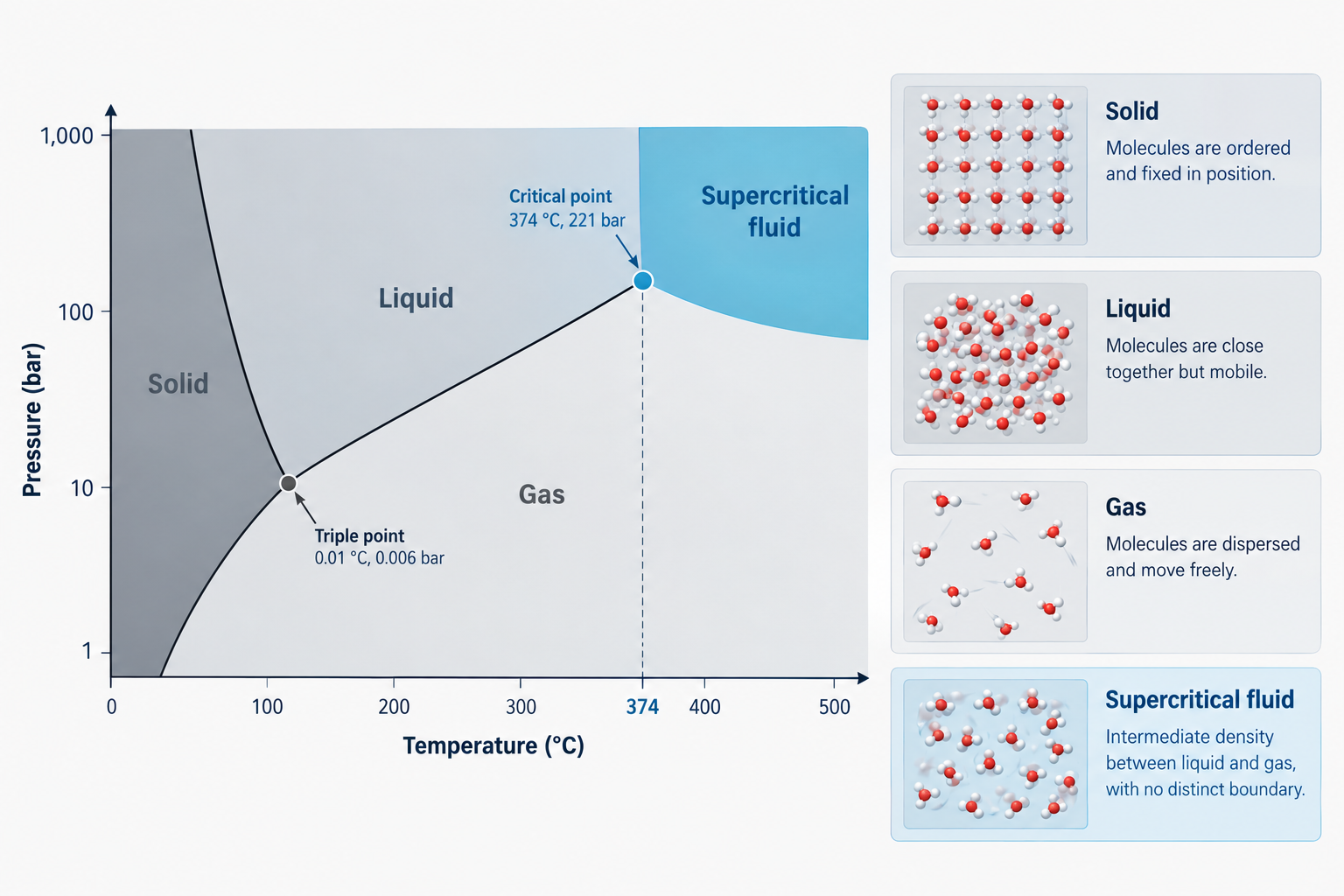
Above 374 °C and 221 bar, water is no longer a liquid or a gas, but a supercritical fluid with properties in between the two. Its dielectric constant drops sharply, making it behave more like an organic solvent, while its density can still be finely tuned by adjusting pressure and temperature. In this environment, metal precursors decompose and nucleate almost instantly, forming nanoparticles in seconds rather than hours.
In our plant, reagents are fed as continuous streams and meet a stream of supercritical water at a dedicated mixing point. The reaction takes place along the reactor, while product is continuously collected downstream. There is no "batch" to load, react, and unload: the process runs without interruption, with temperature, pressure, and flow rate held constant over time.
This difference, which might sound purely mechanical, has direct consequences on the quality of the material obtained. In a batch reactor, mixing and heating are never instantaneous: part of the material nucleates earlier, part later, under local conditions of temperature and concentration that keep changing as the reaction proceeds. This typically results in a broader size distribution, lower batch-to-batch reproducibility, and dead time linked to loading, heating, and unloading the reactor.
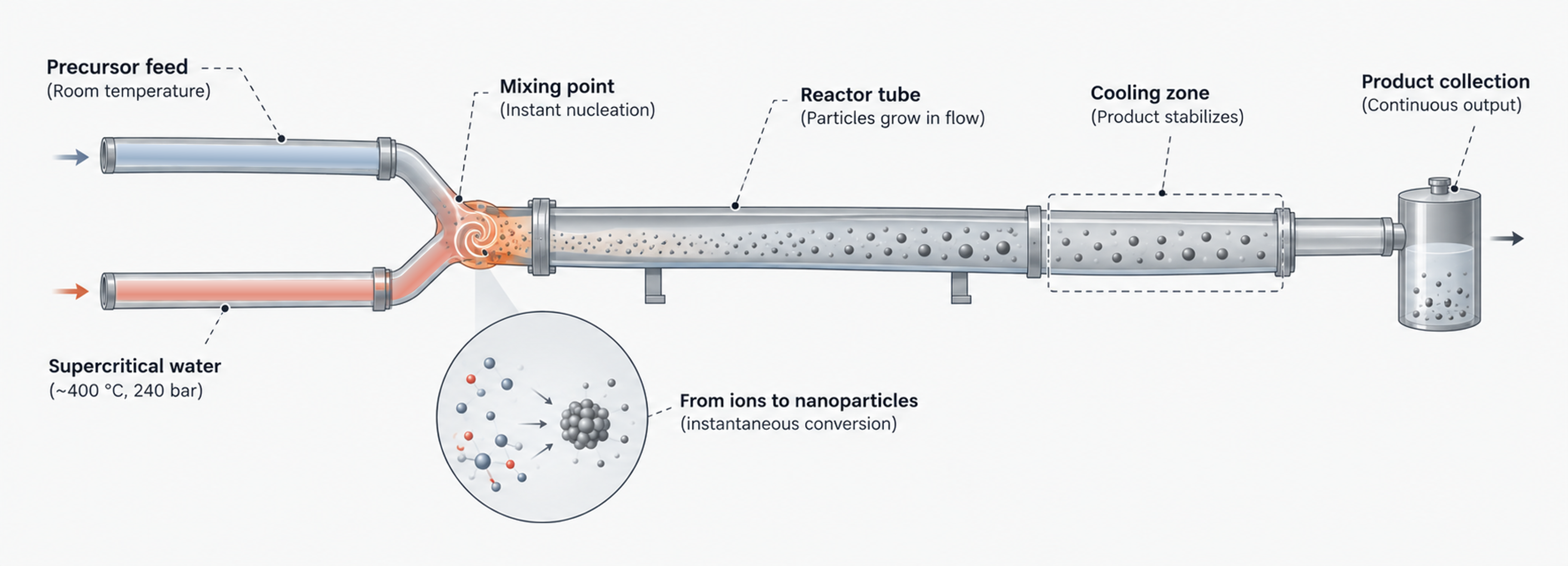
In a continuous process, every "packet" of reagents experiences essentially identical reaction conditions, since temperature, pressure, and residence time are fixed by the plant design rather than depending on the volume being processed. The result is more homogeneous, more reproducible particles, batch after batch; easier scale-up, since increasing output means running the plant longer rather than redesigning the reactor; and reduced use of organic solvents and auxiliary reagents, thanks to the "green" role played by water itself. There are also benefits in terms of safety and operational efficiency: the volume of fluid under critical conditions present in the reactor at any given moment is small, and the process lends itself more easily to real-time monitoring and control.
It is no coincidence that continuous hydrothermal synthesis in supercritical water is today considered one of the most promising routes to sustainable, scalable production of high-quality nanomaterials, from catalysts to materials for energy applications.