Morphology: not all nanoparticles are born round
Nanoparticles come in all sorts of shapes. Even if they are typically sketched as round objects, in reality they can be rounded or faceted according to the Platonic solids; elongated or oblate, forming rod-like or disc-like structures; or, under certain conditions, forced to assume metastable complex shapes such as tetrapods, stars, urchins, and many more.
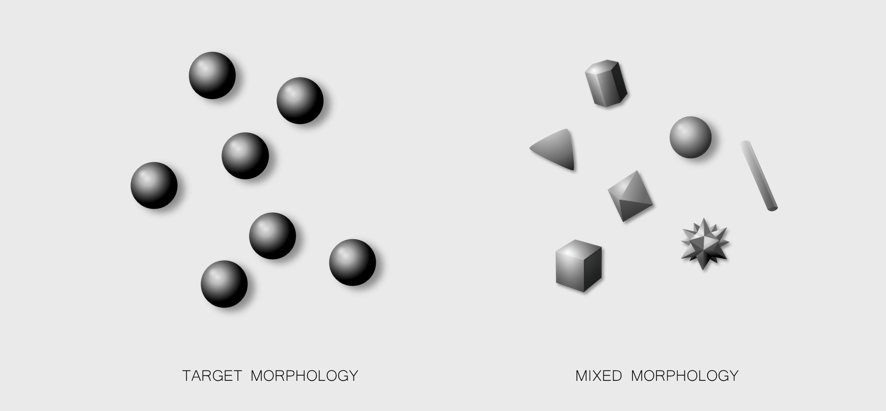
Shape becomes a determining factor in a number of applications: in polymer composites, one-dimensional rods or fibres can be used to maximise mechanical performance along aspecific direction; in paints and varnishes, anisotropic optical behaviour is exploited to introduce colour effects; in biochemistry, the plasmonic optical response of a nanoparticle depends directly on its geometry; and in catalysis, certain crystalline facets exhibit higher reactivity towards specific processes.
Not all nanoparticles are born round!