Aggregation: why nanoparticles stick and why it matters
Aggregation occurs whenever single nanoparticles cluster together, forming larger objects. This happens through surface attractive interactions which, while always present, become significant only at the nanoscale, where particles can come nanometrically close to one another.
Unlike our everyday experience, where aggregates of dust or powder seem easy to break apart with mechanical or chemical force, nanoparticle aggregates require a surprisingly large amount of energy to be disrupted. This is due to the enormous number of surface-to-surface interactions per unit volume and the extreme proximity of the surfaces themselves, so much so that it is often easier to melt the material entirely than to break a cluster apart. For practical purposes, a nanoaggregate should be treated as the fundamental unit when working with these materials.
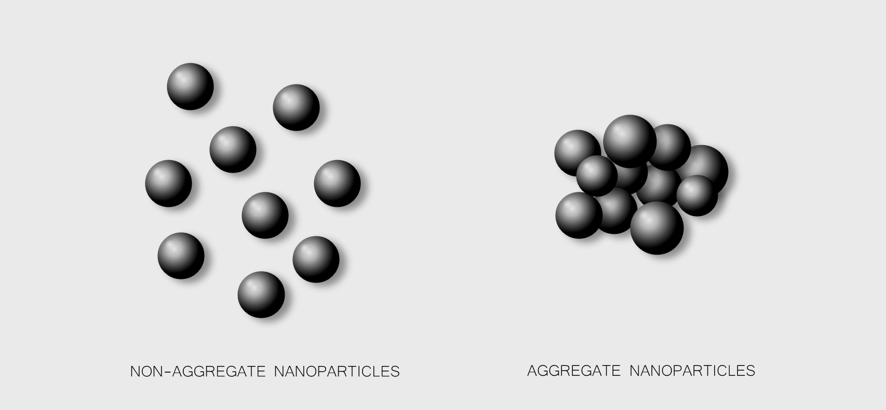
The presence of aggregates introduces several drawbacks: they settle faster, reduce accessible surface area, block pores and channels, scatter light, and they are generally difficult to control. As a result, the advantages of high-quality, monodispersed nanoparticles are largely lost once aggregation occurs, both in terms of performance and processability.
Aggregation is a thermodynamic process that becomes a concern when certain conditions are met. It depends on parameters such as temperature, concentration, composition and surface charge of the nanoparticles, as well as the dielectric constant and ionic strength of the medium and the presence of surfactants. Because aggregation is essentially irreversible, all these parameters must be carefully controlled from synthesis through to the final application in order to achieve reliable material and process performance.